
Oakland Township Previous Residents by Era
Different Oakland Township sources answer different parts of a house-history question. The township assessment layer connects a present address to a parcel and legal description. Recorded land instruments then show a transfer trail. Historical directories and census schedules add household context, but only for the dates and places their compilers covered. Oakland Township has no verified, complete historic address-renumbering table, so an older street number should never be silently converted to a modern one. Compare legal descriptions, maps, parcel identifiers, and the source date instead.
| Source | Years it covers | Where held | What it can show |
|---|---|---|---|
| BS&A parcel record | Public system start not stated | Oakland Township | Parcel/PIN, situs, assessment, tax, sale, and building-record clues when displayed |
| Super Index | Online from January 1, 1964, except subdivision plats | Oakland County Register of Deeds | Recorded instrument references, parties, dates, and legal-description clues |
| FamilySearch deed collection | 1821–1926 | Museum checklist finding aid | Older Oakland County deed research leads |
| Federal census | 1790–1950 releases | National Archives and library research channels | Historical household snapshots and nearby households |
| Local directories and newspapers | Exact Oakland/Rochester runs not published | RHPL and Library of Michigan reference channels | Address, household, occupation, and move clues when a volume exists |
For a recent Oakland Township transfer, begin with the parcel and recorded deed. For an older household question, use the parcel as the anchor, then test directory and census evidence against it. A gap is meaningful: it may reflect an unavailable volume, an indexing delay, a changed address format, or a source that did not cover rural parts of Oakland Township.
Oakland Township Previous Residents: Three Layers
Oakland Township research works best when three layers remain separate. BS&A Online is the Oakland Township entry point for address, owner-name, parcel-number, and Building Department Record Number searches. It can supply the current parcel context and notes that its Tax Information tab displays seven years of tax history. The county’s Property Gateway supplies map geometry, aerial and report context. The Register of Deeds supplies the recorded instruments that establish a legal transfer trail.
In Oakland Township, these layers should not be collapsed into one conclusion. A situs address is the location of land; a mailing address is where correspondence may go. A published owner name is not, by itself, proof that a person lived at the property. Likewise, a permit can document work at an address without identifying a household. Keep a short research log with the date searched, the PIN, the address spelling, and the exact record type. That makes later corrections possible when systems update on different schedules.
- PIN or parcel number
- The parcel identifier used by property systems. Oakland County commonly treats the PIN as a ten-digit identifier, although display formats differ.
- Situs address
- The physical land location. It can differ from an owner’s published mailing address.
- Legal description
- The lot, section, subdivision, or metes-and-bounds description used to identify land in recorded documents.
- Chain of title
- The sequence of recorded conveyances used to follow a property backward through owners and instruments.
Note: A no-result in one public interface is not proof that the older paper file or an earlier record does not exist.
Oakland Township Previous Residents Through Deed Records
For Oakland Township land, the Oakland County Super Index is the recorded-land starting point. Guest index search is free, while details or document images cost money. County instructions describe online indexed records and images back to January 1, 1964, apart from subdivision plats, while the broader county collection reaches into the early 1800s. The date marks online coverage, not proof that every historical instrument is digitized or that every older name is complete in one search.
The Super Index can be searched for an Oakland Township parcel using a name, address, PIN, recording date, liber/page, or document number. Capture the instrument number, recording date, document type, legal-description text, and every linked reference. A grantor transfers an interest; a grantee receives one. Those roles matter because a purchase deed commonly names the buyer as grantee and the seller as grantor. A later mortgage, release, lien, foreclosure instrument, or plat can be a separate record and should be searched separately.
The Super Index search screen shows Oakland Township researchers the county’s index and advanced-search controls before an image purchase is needed.
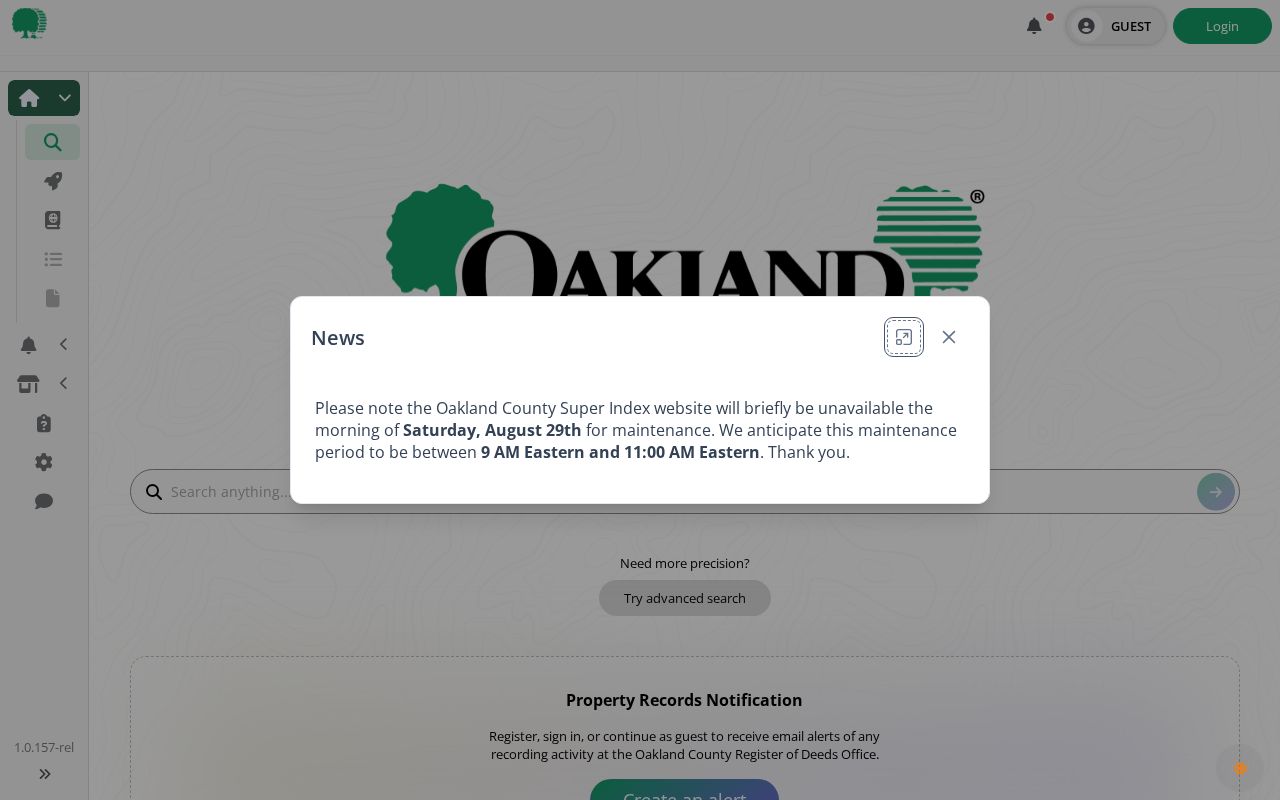
Use a result as an Oakland Township citation lead, then compare the instrument with the parcel’s legal description instead of relying on a surname match alone.
- Find the current parcel in BS&A or Property Gateway and record the PIN, situs address, legal description, and any public sale clue.
- Search the current owner as a grantee in Super Index, then save the purchase deed’s recording date, instrument number, and grantor name.
- Search that seller as a grantee for an earlier purchase, while also testing the PIN, legal-description wording, liber/page, and document number.
- Repeat the sequence one conveyance at a time. Search mortgages, releases, assignments, liens, foreclosure instruments, and plats as parallel records.
- When the online index does not cover the needed period, ask the Register of Deeds about the applicable counter, book, or microfilm path rather than guessing at a cutoff.
Oakland Township Previous Residents Before 1964
The online Super Index is only one part of the Oakland Township land-record timeline. Oakland County describes its historical land collection as reaching to the early 1800s, but the research did not verify an exact pre-1964 counter or microfilm cutoff. Ask the Register of Deeds which access channel applies to the specific instrument or grantor-grantee book needed. Do not describe an unverified counter procedure as if it were an online search feature.
The Rochester Hills Museum’s house-history checklist identifies a FamilySearch Oakland County deed collection for 1821–1926. It is a useful Oakland Township finding channel, not a replacement for the recorded county instrument. The same checklist points to historic atlases, maps, aerials, newspapers, yearbooks, and local-history collections. Those materials can explain a road, farm, plat, or building over time, but their provenance varies. Mark whether a fact comes from an original record, an index, a transcription, OCR, or an oral-history account.
The Library of Congress four-sheet Rochester fire-insurance map from April 1908 can help place an Oakland Township-adjacent commercial or urban Rochester setting, but it is not a complete map of rural Oakland Township. Missing from a Sanborn sheet does not mean absent from the township. The legal description, older atlas, current PIN, and dated aerial should carry more weight in a property-specific conclusion.
Oakland Township Previous Residents in Directories
Oakland Township directories can add the household layer that deeds do not provide. The Library of Michigan explains that Polk entries may include occupation, household members, owner or occupant clues, and street address. Street sections can list house numbers in alphabetical street order. Bresser and cross directories may add street order, a head of household, phone listing, first listings, new arrivals, relocations, and building information. What appears depends on the volume and its abbreviation key.
Exact Oakland Township and Rochester directory titles and years were not published on the public pages reviewed. The reliable next step for an Oakland Township address is the Oakland Township Directory Book, then Rochester Hills Public Library or the Library of Michigan reference guide for the precise volume. RHPL offers local-history assistance, atlases, obituaries, vertical files, and Rochester-area newspaper microfilm. The state guide describes print, rare-book, microfilm, fiche, Ancestry Library Edition, and HeritageQuest holdings. These are complementary access channels, not interchangeable catalogs.
Search each address in street order, then test surname entries and nearby numbers. Preserve initials, spelling variants, abbreviations, and postal-place variants such as Rochester, Rochester Hills, Goodison, Oakland, and Oakland Township. One absent year does not show a household left. The directory may not exist, may use a different heading, or may cover only part of the local area.
Note: Confirm every abbreviation against the key printed in the specific directory before treating it as a family or property fact.
Oakland Township Previous Residents in Census Records
Oakland Township census research provides dated snapshots rather than a continuous address file. The National Archives makes census releases from 1790 through 1950 available under the 72-year rule. They can show a household, ages, birthplace, farm status, and nearby households, yet enumeration geography and spelling can change. The 1890 schedules were largely destroyed in a 1921 fire, so a missing household there does not prove that a family was absent from Oakland Township.
Pair each usable Oakland Township directory year with nearby census releases, then test the connection against a parcel, deed, map, newspaper image, or probate record. Rochester Hills Public Library’s local-history resources include selected Rochester Era, Rochester Clarion, and Rochester Eccentric microfilm, while the Museum checklist identifies a searchable newspaper viewer for titles including Rochester News, Rochester Plaindealer, Rochester Weekly Sun, Avon News and Shopper, and The Spectator. OCR is a finding aid. Read the underlying page image before recording a name or road.
Oakland Township obituaries, cemetery information, and probate records can help close a historical trail, but they should not be used to create a profile of a living person. The county Probate Court’s older file context reaches back to about 1822, while public index access and document access are separate questions. Record the source date and role, then distinguish a historical household link from present residence.
Oakland Township House-History Evidence
A careful Oakland Township house history is a source bundle, not a single search result. Start with the current address, PIN, and legal description. Add the deed chain, assessment or tax references, census snapshots, directory entries, plats or atlases, aerials, newspaper references, and any public building record. The source itself should stay beside every finding, along with a retrieval date and the identifier used. That is especially important when one address carries a township jurisdiction but a Rochester or Rochester Hills postal label.
Use the county’s dated property-fraud guidance as a reminder to verify an Oakland Township recorded instrument directly. A notice or alert can prompt a check, but the legal description, grantor/grantee roles, recording date, and instrument number are the stronger evidence. If a historic road name appears, test it against maps and legal descriptions. No verified Oakland Township-wide renumbering year or complete historic-to-modern road crosswalk was located, so an assumed address conversion would weaken the chain.
House-history use. Oakland Township past-resident research is best used for family history, estate questions, local history, and checking a property record. Do not use historical sources to follow, contact, or pressure a living person.
Oakland Township Previous Residents: Research Boundaries
For Oakland Township, recorded ownership and historical occupancy are different claims. A deed can establish that an interest was conveyed. A directory or census entry may place a household in a historical setting. Neither one establishes a current address, and neither compensates for a missing source. Treat each result as a dated record that needs corroboration with a PIN, legal description, document number, road clue, family relationship, or other non-name detail.
Oakland Township public-record research also has real limits. Address Confidentiality Program locations, protected voter fields, driver-record information, private association materials, and unnecessary personal identifiers should not be pursued or repeated. Michigan’s anti-stalking statute, MCL 750.411h, makes repeated unconsented contact or harassment a serious legal matter. Keep the work focused on the property’s documented past and verify a contested record with its custodian.
Note: Use “no result located in the searched official portal as of the search date” when evidence is absent rather than making a definitive claim.